Loop overview
Role Principal Software Engineer — a restaurant-technology & payments company building cloud POS, integrated payments, online ordering with kitchen routing, reservations, and labor management. Flagship differentiator: offline-first POS that continues taking orders and card payments during internet outages, then syncs and reconciles after reconnect. Postings emphasize zero tolerance for data loss on transactions, distributed-systems ambiguity, and PCI-aware design.
Panel Two Staff engineers and one Principal engineer. Stack signals from the JD and public engineering content: Go, Python, TypeScript/React, Kotlin Android POS, PostgreSQL, Kafka, AWS, hundreds of microservices.
Rounds
- System design — 60 minutes, full panel (Interviewer A, B, C)
- Behavioral — 45 minutes, hiring manager (not covered in this sample)
Behavioral story bank and hiring-manager round prep require your résumé and prior project narratives; those sections are omitted here.
| Round date | Prep focus (from your plan) |
|---|---|
| Thursday — system design | Offline-first POS + payments reconciliation; panel-specific probes from A (client boundaries) and B (reliability, testing, ops) |
| Friday — behavioral | Ownership under ambiguity, cross-team influence, incident/postmortem narratives (requires your material) |
Panel briefing
Interviewer A — Staff Engineer, frontend platform
Long tenure at a large enterprise-software company before joining; works on frontend platform architecture and contributes to open-source developer tooling. Likely probes: client-side module boundaries, how offline state is owned across POS web and Android shells, API contract stability when sync catches up, and whether your design leaks distributed concerns into the UI layer.
Confidence: high — multiple public profiles and conference/tooling footprints align with the scheduled name and role.
Interviewer B — Principal Engineer, cross-cutting technical lead
Cross-cutting technical lead with a cloud and distributed-systems background; public footprint shows deep investment in testing infrastructure and engineering quality. Likely probes: reliability under partition, how you test the offline path before production, idempotency and replay safety, observability for stuck syncs, and blast-radius containment during rollout of payment-impacting changes.
Confidence: high — public writing and talks corroborate role and focus areas.
Interviewer C — Staff Engineer
Listed on the interview schedule with a Staff title; no corroborating public profile, publication trail, or conference presence found after searching name + employer + role. Cannot infer specialization (payments, mobile POS, infra, or product surface).
Confidence: unverified — generic preparation advised — treat this card as a general Staff-level systems probe. Prepare breadth: API design, operability, failure modes, and trade-off articulation without assuming a domain wedge.
Predicted questions
Ranked system-design predictions for the Thursday panel round. Rationale ties JD language, public technical differentiators, and panel composition.
-
Design a restaurant POS that staff use to take orders.
Rationale: the company's core product. The prompt sounds simple — the evaluation lives in whether you surface offline-first operation and order durability unprompted (their flagship differentiator; JD stresses zero transaction data loss).
Confidence: high
This prediction matched the question asked in the actual interview. -
Design multi-channel order ingestion (in-store POS, online, third-party delivery) with kitchen routing and consistent order state.
Rationale: product surface area beyond offline POS; exercises distributed ingestion, routing rules, and consistency across channels.
Confidence: medium-high -
Design a payments pipeline: authorization, capture, settlement, idempotency, and PCI scope boundaries.
Rationale: integrated payments + PCI-aware design called out in postings; natural follow-on if the panel wants depth without repeating the full offline POS prompt.
Confidence: medium
Walkthrough excerpt: predicted question #1
Excerpted from a ~15-page walkthrough document. Full version includes sequence charts, capacity math, and round-specific follow-up banks.
1 · Clarify system scope
- It's a one-hour round — cut aggressively and say so: order-taking only. Payments, reservations, and inventory are adjacent systems you integrate with, not things you design today.
- One store first. Multi-location is a scale topic, not a starting point.
- Devices: fixed terminals and handhelds on a shared store network; kitchen display at the end of the flow.
- The scope question that earns signal: "what happens when the internet goes out during dinner rush?" Offline-first is their flagship differentiator — put it in scope before being asked.
2 · Functional & non-functional requirements
Functional: create and edit orders by table or tab; menu with modifiers and 86'd items; fire courses to the kitchen.
Non-functional — where this round is actually decided:
- Availability over consistency: staff keep taking orders through any outage — LAN, WAN, or cloud.
- No committed order is ever lost — the JD's "zero tolerance for data loss" language makes durability a hard constraint.
- Local interactions under ~100ms during rush, independent of cloud health.
3 · Core entities & API contract
Entities: Order, OrderLine, MenuItem, Table. One decision to surface while drawing them: client-generated IDs (ULIDs) — devices create orders offline, so the server can never be the ID authority.
Contract sketch — device ↔ cloud is event-based, not CRUD:
POST /sync/events— batched order events, each carryingidempotency_key(device_id + local_seq); returns per-event acks and a server cursorGET /sync/changes?cursor=…— menu updates and cross-device order state
4 · Scale considerations
The trap is sizing this like a consumer app. One store is tiny — dozens of devices, hundreds of covers a night; a phone could serve it. The real scale is the fleet: tens of thousands of locations bursting at the same meal hours through your sync fan-in. Per-store it's a correctness problem; fleet-wide it's a throughput problem. Naming that split is the Principal move.
5 · High-level design
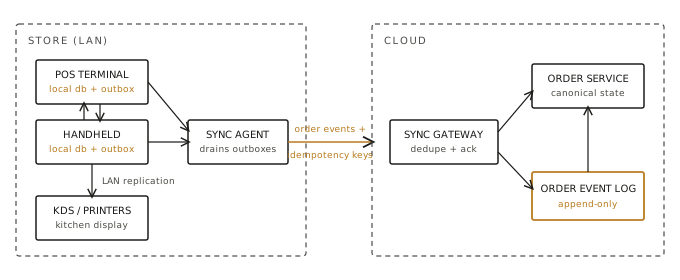
Devices are local-first: every write commits to on-device durable storage and an outbox before any network call. Devices replicate over the store LAN — orders reach the kitchen display even with the WAN down — and a sync agent drains outboxes to the cloud when connectivity allows. Cloud side: the sync gateway dedupes on idempotency keys and acks; the order service owns canonical state on an append-only order event log.
6 · Deep dives (where this panel took it)
- Offline durability: define what "committed" means on a device — a durable local write plus an outbox entry; budget storage for a multi-hour outage; know what staff see when a device dies mid-shift.
- Idempotent replay: at-least-once delivery end to end; the server dedupes on the client key before any side effect, so a reconnect storm can't double-fire kitchen tickets.
- Conflict resolution during partition: two devices edit the same order — additive lines merge cleanly; voids and edits want last-writer-wins with operator attribution and conflicts surfaced in the UX, not silent convergence.
What separates a Senior answer from a Principal answer here: A Senior designs the happy path and adds retries. A Principal cuts payments from scope and defends the cut, quantifies the offline window (storage budget, maximum divergence time), designs the event log and replay semantics first, and closes with rollout: shadow mode → canary stores → a kill switch keyed to sync-lag SLO breach.
Likely follow-ups (Interviewer B — reliability focus)
- How do you test the offline path? Fault-injection at the network layer (toxiproxy) on real device profiles; property tests replaying reordering and duplicate delivery; a game-day where a store runs two hours partitioned.
- What's the observability story for stuck syncs? Per-device sync cursor lag, age of the oldest unacknowledged event, and an alert on device-vs-cloud order count divergence — so support can answer "did table 12's order reach the kitchen?" without reading device logs.
From the day-by-day plan
Excerpt from a paced plan keyed to your round dates (system design Thursday, behavioral Friday).
- Two days before system design round (Tuesday): Whiteboard the POS question end-to-end once without notes, running the full format — scope → requirements → entities & API → scale → high-level design → deep dives — in 35 minutes. Focus on the order event log and idempotency key placement. Re-read Interviewer B card; draft two concrete testing strategies (automated fault injection + game-day). Skim PCI scope boundaries: what never touches the POS app vs what stays in the payment gateway.
- Day before system design round (Wednesday): Timed 45-minute mock with a colleague playing Interviewer A — push on module boundaries between order UI, local outbox, and sync agent. Prepare one crisp answer on CRDT vs LWW for order edits with a restaurant-specific example (void after kitchen bump).
- Morning of system design round (Thursday): 15-minute review of predicted question #1 outline only — do not cram new material. Bring three clarification questions written down; plan to ask two in the first ten minutes.
Sample redacted and excerpted from a real founding-customer-style package. Names and employer withheld.